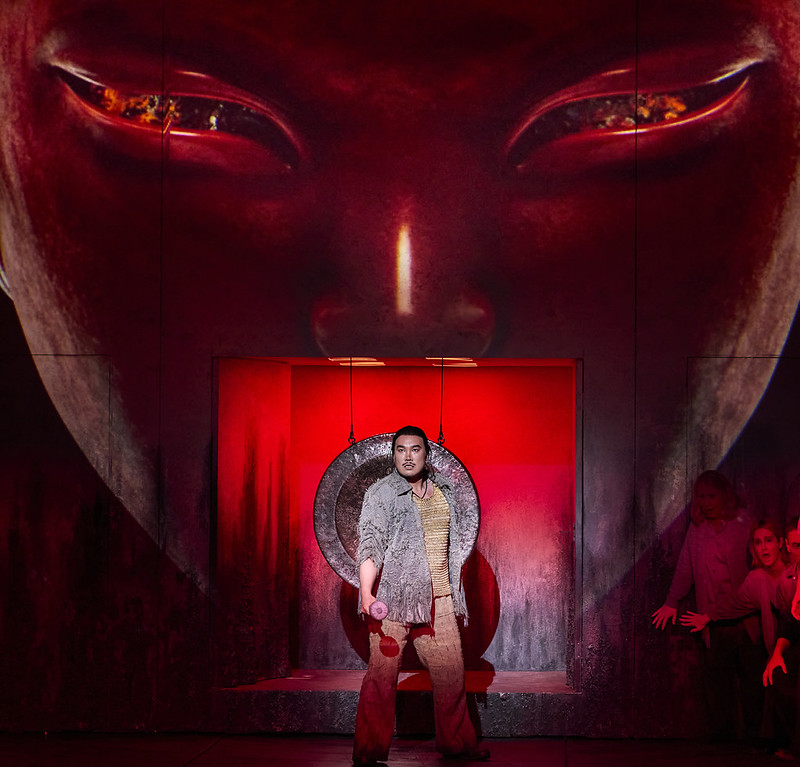
Turandot is one of the most well-known operas in the world, and it has returned to the Sydney Opera House with the first new production in 35 years. This production, featuring new direction from Ann Yee, includes arguably the most well-known aria in the operatic world in “Nessun Dorma”. With that said, it is an opera which perhaps does not age as well as others, with its lackadaisical plot and extreme racial stereotypes that can often plague its performance, making it an interesting and challenging production to put on.
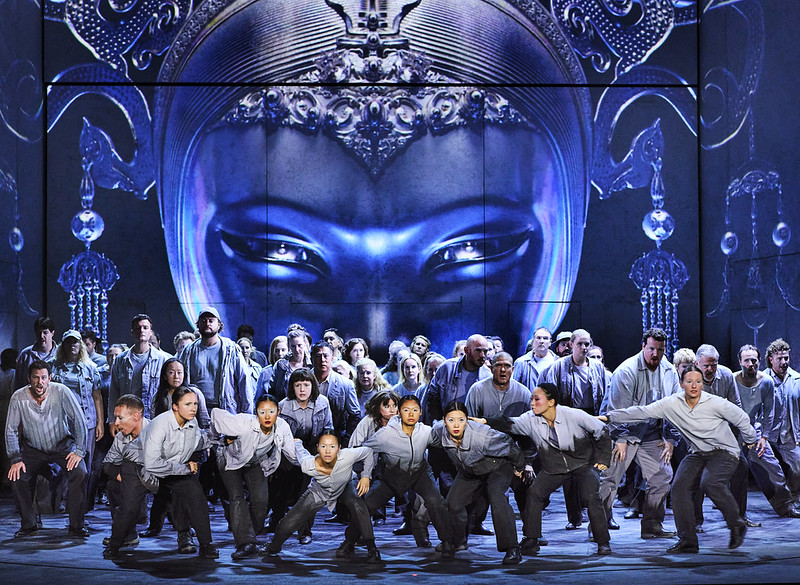
It is rare to lead an opera review with discussion of the set but this is one production that truly demands it. Thanks to the creative vision of Yee and set designer Elizabeth Gadsby (supported by costumer designer David Fleischer, video director Thomas Andrew Huang and lighting director Paul Jackson), this production was reimagined as a visual spectacle and immediately drew the attention of the audience, with a giant Moloch-looking avatar dominating the first half of the production. It was an arresting sight, and one that clearly captivated the audience by giving much greater context and meaning to the work, evoking an authoritarian hellish landscape with a drab colour pallet very much reminiscent of that in Notre Dame De Paris (a French megamusical with a similar gist although in a completely different context). Opera Australia has led from the front with pushing the boundaries of traditional works and this was certainly no exception.
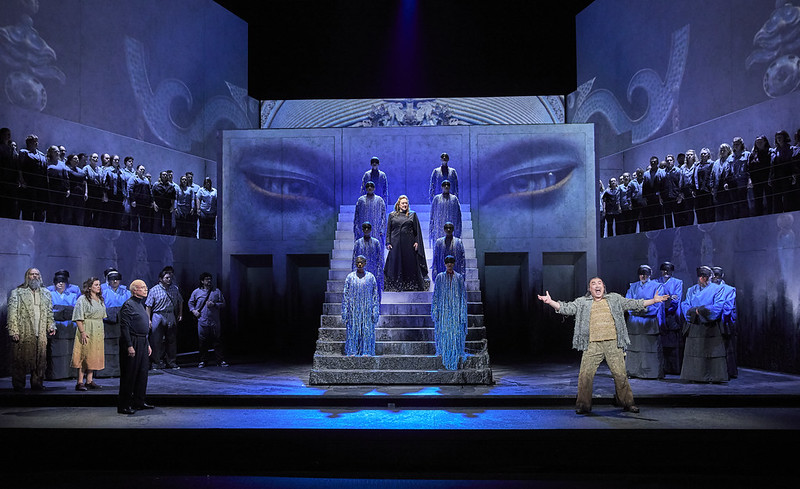
The story tells of an ancient figure, Lou-Ling, who is fighting for her life and her kingdom and Princess Turandot, who rescues her crown before Princess Turandot seeks to marry by having her suitors answer three riddles, the failure of which will result in death. Calaf, the son of Timur, the banished King of the Tartars, takes up the challenge, much to the dismay of his father and his father’s servant Liu, but he passes the riddles. This is much to the disappointment of Turandot, who does not want to marry, as she does not want to forget what happened to Lou-Ling, but she is bound. Calaf then offers her a challenge that if she can learn his name by dawn, he will forfeit his life, which ultimately leads to a beautiful declaration of love.
The vocals in this production are generally quite strong, with Young Woo Kim as Calaf being a clear highlight, showing off an absolutely gorgeous and rich tone with such beauty and warmth that he received a richly deserved standing ovation at the end of the production. He did not quite sustain the biggest notes in “Nessun Dorma” and faltered on a few other notes throughout the production as it seemed he was struggling with some form of illness but the richness and quality of the tone was so strong that it mattered little. Kim may very well be one of the most promising performers in opera at the moment and the more that Opera Australia can put him on their stages, the better for the company and for Australian opera. He is truly a marvel.
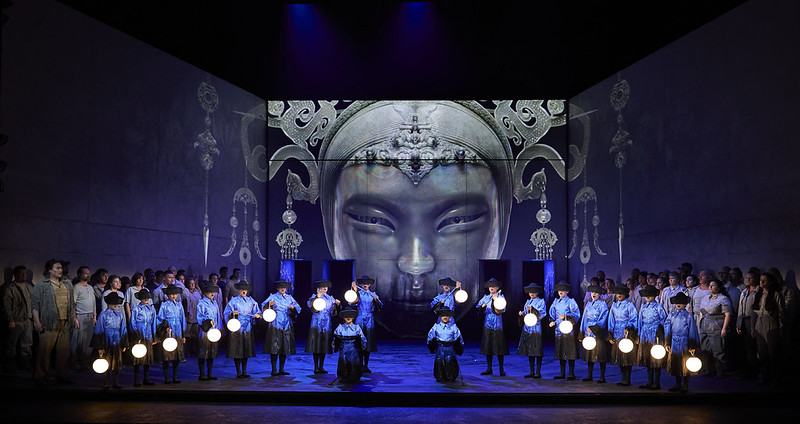
Maria Teresa Leva as Liu was also extraordinary, showing breathtaking control and a beautifully layered tone particularly at the start of the show, while Rebecca Nash’s Turandot made a grand return to Australian opera stages with a fantastic performance as the titular character. P1, P2 and P3 also provided some comic relief, helped by the staging, although they were not quite as strong vocally as some of the other performers on stage. The chorus was in fine form, as always, and well supported by the children’s choir.
The problem with Turandot is and has always been the prevalence of racial stereotypes, which are at their most pronounced in this work. In confronting this, Opera Australia face an unenviable task but have thankfully done away with the yellow facing of P1, P2 and P3 that was a major talking point of their last production of Turandot on Sydney Harbour. The engagement of cultural consultants and an overall willingness to confront these issues and make changes to the original work and staging are certainly admirable but the problematic racial depictions of marginalised groups in the production as “Others” are still pervasive.
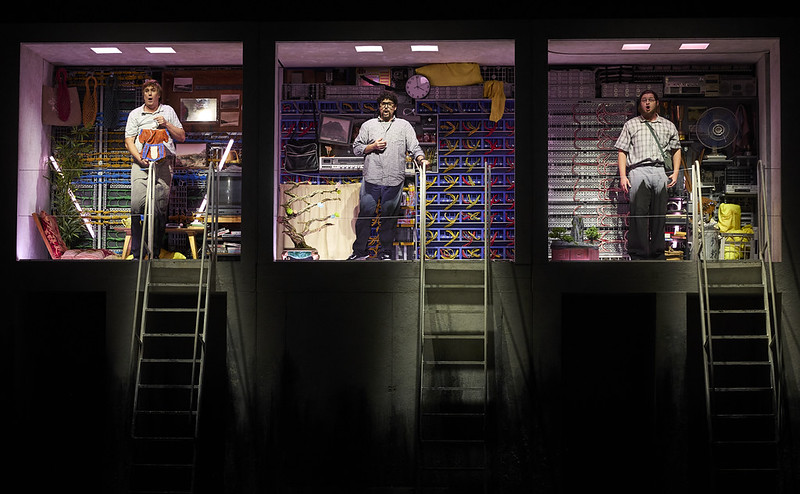
While these are issues that are difficult to reconcile and will continue to be so long as the work is performed, it is perhaps the time to consider more representative casting throughout the production, given the swathes of diverse talent in Opera Australia’s ranks at the moment. This would go a long way to at least providing some sort of counterbalance to the often-dehumanising stereotypes from centuries ago that unfortunately continue to marginalise many in broader society to this day.
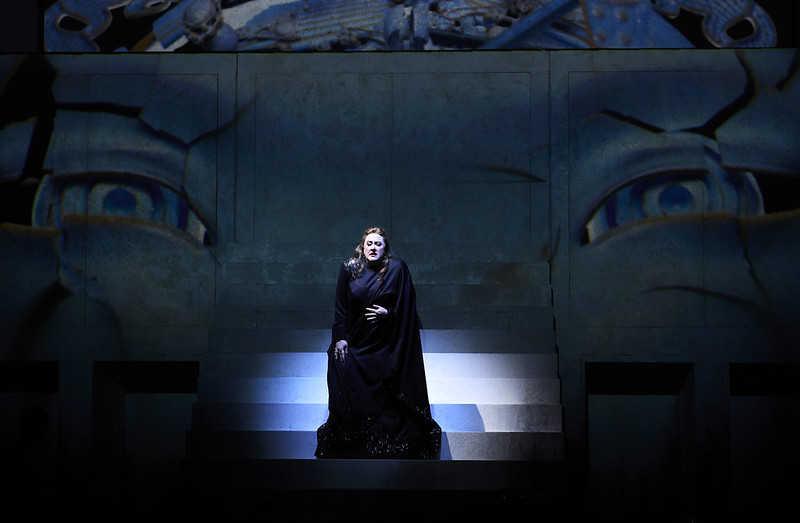
Overall, this is an excellent reimagining of a classic work, with an extraordinarily arresting set and incredible vocal performances that make this production a true must-see. While issues of problematic racial depictions continue to plague this work despite the welcome changes made by Opera Australia to this production, there is no doubt that the music is some of Puccini’s finest and most-recognisable, and it is performed with such richness and beauty that it must be seen to be believed. A must-watch.
Rating: ★★★★1/2
Turandot plays at the Joan Sutherland Theatre until 27 March. For more information, click here.
All photo credits: Keith Saunders

 Musicaltheatre.au - Australian music and theatre reviews