
The stage adaptation of Wuthering Heights is a polarising piece, having turned Emily Bronte’s acclaimed romantic novel into a highly charged postmodern quasi-musical (more on that later). It does so with a freneticism that is at odds with its nearly 3 hour run time and requires a great deal of acting skill on stage and focus from the audience. With this UK production, helmed by Emma Rice, premiering in Australia at the Roslyn Packer Theatre in front of a packed crowd, this was the perfect opportunity to explore this division and see how the production resonated with an audience outside of the UK.
What is notable about this production is that questions of race are foregrounded from the outset. While Bronte’s original novel also confronted issues of race, the politics of ‘Othering’ and exclusion are fleshed out much more in this play, as the central character, Heathcliff’s alienation is charted from the moment he arrives at Wuthering Heights as a small child through to his father’s passing and his descent into adulthood and later, tyranny.
This results in quite a confronting watch, especially in the first act as the play charts through the majority of the plot points in the novel. In this regard, John Leader is superb as Heathcliff, charting his character’s mental descent as the politics around him and the loss he suffers slowly break his spirit. His voice is clear and powerful, amplifying the destruction, both internal and external, from which he suffers. His interpretation is almost Shakespearean, but this plays well into Rice’s vision and into the timbre of the production around him.
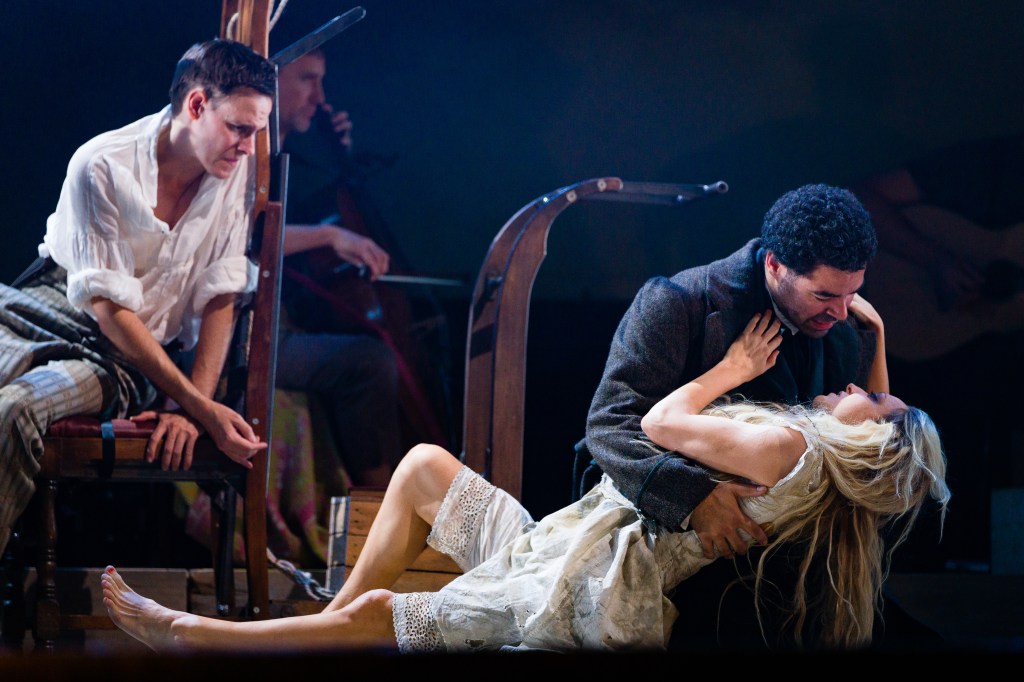
The central plot point is Heathcliff’s relationship with Cathy up until her untimely death and with her ghost, who continues to haunt him. Stephanie Hockley does a fantastic job of playing the difficult role of Cathy, with great effort taken to convey the degree of torture within her and the tension between this and her empathy for Heathcliff, in spite of the familial torture he receives.
While the drama of the production is arresting throughout the first act, the music does not quite fit (although it at least bears some stylistic synergy). It is not quite accurate to call this production a musical as the music itself feels largely superfluous to the story rather than wholly integrated as would be expected from the genre. However, with a live band on stage and regular breaks into angsty music and vocals, the music is a central part of the production that serves as a dampener for the intensity of the rest of the act. The issue is that this results in breaks in dramatic flow and the music itself does not have the strength to draw interest in its own right.

Nonetheless, the drama and intensity of the first act mean that the audience leave the 90 minutes of action with a degree of enthusiasm and anticipation for what is to come. While the second act is much shorter, and traverses considerably less ground plot-wise, it is stylistically bizarre and confusing in its execution. The production essentially turns into a love story juxtaposed with Heathcliff’s desire for ultimate power, with vast tonal shifts as the narrative and music sway through eras and constructs. This makes the second half quite hard to follow as the audience really has no sense of stability, leading to a degree of confusion.
While experimentation can often be successful and indeed, integral for pushing the boundaries of the theatre landscape, in this case, the second act pushes this too far. The dramatic energy of the first act is almost completely lost as the production descends into caricature and farce. While this certainly counteracts some of the intensity of the production, ultimately, it means that it loses the essence of what makes it special.

This is a play that is defined by its attempts at experimentation and by the quality of the acting. From the entire 11-person strong cast, the acting is phenomenal, and the material is handled extremely well. However, the experimentation in this production does not quite work, with its great strength being the intensity of the story and of the production which is lost in the second act. It is certainly an interesting piece of theatre for an audience member, but perhaps one that will leave many a little befuddled rather than invigorated when leaving the theatre.
Rating: ★★★★
Wuthering Heights plays at the Roslyn Packer Theatre until 15th February 2025. For more information, click here.
All photo credits: Steve Tanner

 Musicaltheatre.au - Australian music and theatre reviews