
For the penultimate play in the Ensemble Theatre season, audiences are presented with another commissioned work, this time the world premiere of Sam O’Sullivan’s political satire, McGuffin Park. Set in the fictional town of McGuffin, the play follows two friends turned mayoral candidates, Fiona, a local baker, and Jack, a teacher with aspirations at a tilt in the state government. While political plays come across Sydney stages quite frequently, this one has a uniquely Australian slant, which makes an immediately compelling watch for the sold-out opening night crowd.
In the play, after Jack convinces Fiona to run for McGuffin mayor, he decides to run himself, causing friction between the long-time friends. Various attempts at negotiation and wheeling-and-dealing ensue, with increasingly dastardly schemes being implemented by both characters, much to the surprise of Fiona herself, who never set out to become entangled in the political landscape in such a way. All of this culminates in an interesting reveal at the end of the play, as the successful mayoral candidate is announced.

The quality of the acting in this play is consistently strong, with each performer playing a swathe of characters. Eloise Snape is convincing as Fiona while Jamie Oxenbould and Thomas Campbell are suitably hilarious in all their roles. But the true star of the show is Shan-Ree Tan who gives a compelling (and quietly Machiavellian) performance as Jack, performing with a charisma and clarity that brings life to the performance on the stage.
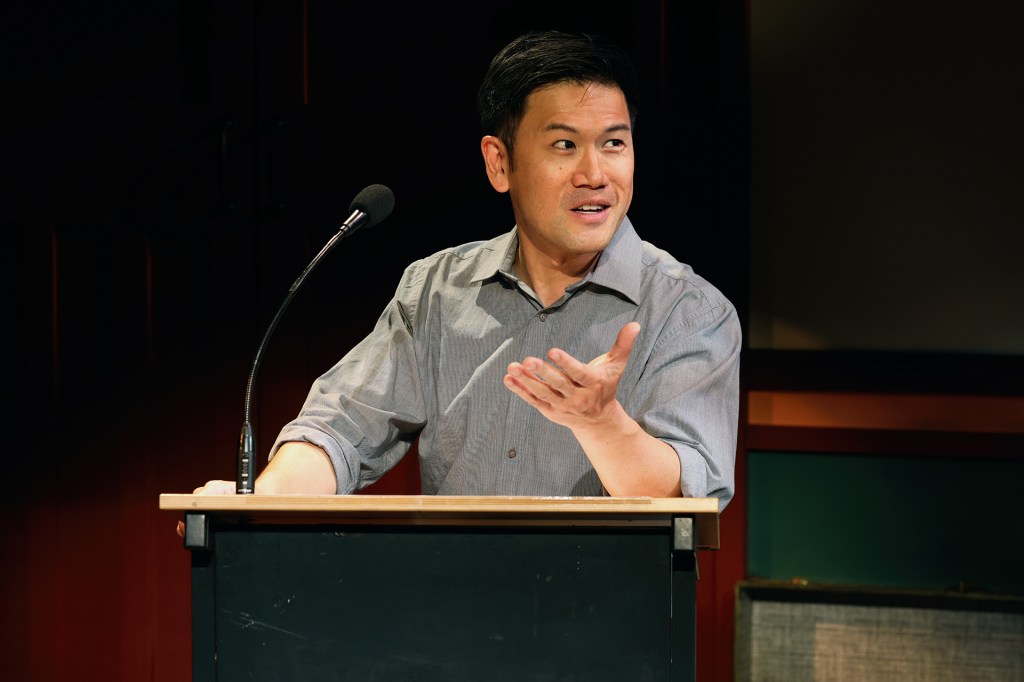
The subject matter is also very interesting, being acutely concerned with the political process and the emotions that accompany it. It also makes contemporary jabs at movements such as the ‘sovereign citizens’ movement which provide much-needed humour into the show. However, it feels as though an opportunity is missed to say something more poignant about the impact of the political process at the end of the play, when the final mayoral speech is being given. The moment is perfect for something truly meaningful and yet, at the end of the play, despite there being a hint of irony and a degree of cyclicity, there is a slight lack of finality that is lingers from within the audience.

The frequent references to Brecht and to the concepts of Brechtian theatre are also quite off-putting and seem almost singularly focussed at a very specific demographic of theatregoers, who find these types of metatheatrical ‘in-jokes’ amusing. Unfortunately, this does risk alienating a larger part of the audience and perhaps more importantly, disrupts the flow of the play, which is otherwise extremely engaging. It ultimately feels quite unnecessary in a show with clever writing and an interesting plot to drive it along with a degree of frivolity.
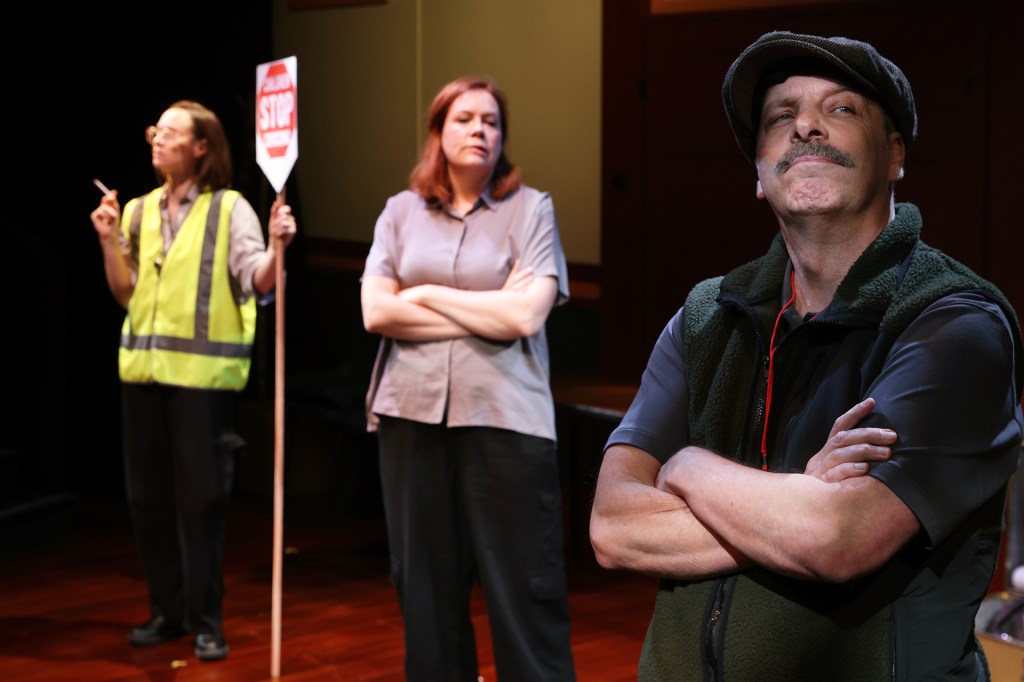
Additionally, the pacing of the play is not perfectly spaced, with the second act feeling slightly rushed and the first act feeling drawn out with somewhat ancillary detail. The initial brochures for the play stated that the running time was 90 minutes without an interval however, the actual running time is around 130 minutes including the interval. With such punchy and intriguing subject matter, a tighter construction (perhaps as initially envisaged), would have been beneficial.
Ultimately, this is a play where its strengths lie in the quality of the acting, the intrigue of the storyline and the craft of the writing. It is not a perfect play, but it is still one that is very enjoyable and for that reason, especially within the context of today’s fraught political environment, this is certainly worth watching.
Rating: ★★★★
McGuffin Park plays at the Ensemble Theatre until 23rd November. For more information, click here.
Photo credits: Prudence Upton

 Musicaltheatre.au - Australian music and theatre reviews