
This season at the Ensemble Theatre has certainly been one of interesting and eclectically chosen plays so far. From sports-themed plays to Australian premieres, a lot of ground has been traversed both thematically and structurally. One constant among the plays chosen is that, in large part, they have focussed quite heavily on the study of character as a dramatic device.
Master Class is perhaps the most obvious example of this pattern as the play focusses solely on a fictional dramatization of the life of Maria Callas, an opera singer leading a tertiary master class at an American conservatorium towards the end of her life. Famous for her brusque nature in real life, Terrence McNally’s play is far from a sympathetic characterisation of Callas, but rather one that seeks to convey a deeply complex figure, interspersed with exposition that attempts to explain the development of her character.
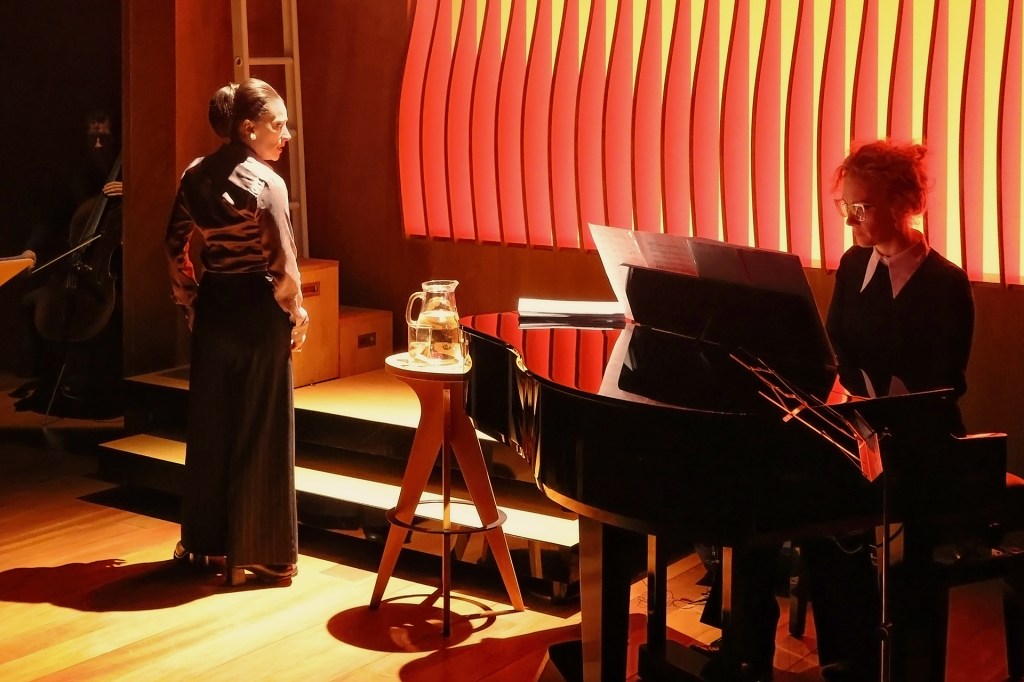
The vast majority of the play is confined to the actual master class itself, where Callas (Lucia Mastrantone) coaches three aspiring opera singers in front of their class mates.

While the three singers (played by Bridget Patterson, Matthew Reardon and Elisa Colla) receive an ample amount of stage time, it is clear that this is Callas’ show, with her quips to the artists and the audience carrying the dramatic weight of the play.
In this regard, Mastrantone is utterly superb. She commands the stage from the minute she enters with her sardonic humour biting through the text. She brings a veneer pleasantry to the character, only superficially hiding the narcissism and nastiness that lurks beneath the surface. A silent groan ripples through the audience every time that Callas says that the masterclass is not about her, because it and the play as a whole, very much are.
Patterson, Reardon and Colla are also excellent when they have the chance to shine, with Reardon in particular perfectly embodying the archetype of the arrogant tenor (and, as an aside, showing he has the vocal chops to back it up). All three typify the range of students a new teacher will face and provide the ideal foil to allow Mastrantone to work her magic.

Ultimately, what lets this production down slightly is something out of the performers’ control, the play itself. Ben Brantley of The New York Times, when reviewing the 2011 Broadway revival of the play said, “’Master Class’ is not, by even a generous reckoning, a very good play, though it can be an entertaining one.”
The exposition of the play rambles, with a run time spanning well over two hours. While elements of the master class are interesting and revealing, ultimately, there is not enough development of character or unravelling of motivation to justify such a length and the play suffers as a result. While the two flashback scenes that bookend the play provide useful context into the mind of Callas, it feels as though they are, essentially, the only form of narrative development in the entire show, when in fact it should be foregrounded in the text.
With that said, the acting is what makes this play and the novelty of the premise still draws the audience in, even if it loses them throughout parts of the show. The cast received three standing ovations which were richly deserved and a testament to the skill they showed on stage, maximising every part of the text. Overall, this was a strong production, which had many of the hallmarks of a great production. If the text were a little more streamlined and perhaps reorganised, it would only be even sharper.
Rating: ★★★★
Masterclass plays at the Ensemble Theatre until 20th July. For more information, click here.
All photo credits: Prudence Upton

 Musicaltheatre.au - Australian music and theatre reviews